Why a Spoon’s Bowl Changes Shape from Handle to Tip
Why a spoon’s bowl changes shape: learn to read its curve, depth, and outline to understand how it gathers food, guides a pour, and feels in hand.
Why does a spoon’s bowl change shape from the narrow neck to the rounded tip? Look at the curve and outline, and you can often tell how the spoon is meant to gather, carry, or release its contents. A bowl is not simply a shallow dish attached to a handle; its changing form guides both the hand and the food.
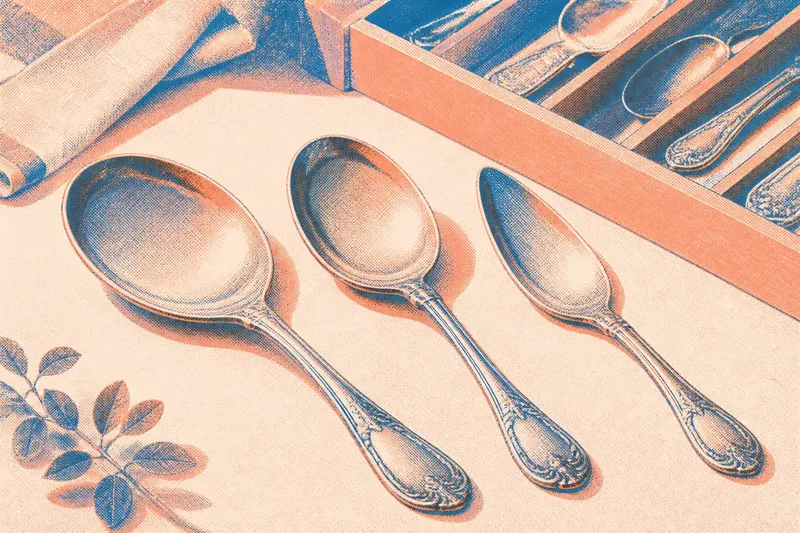
Imagine you inherit a mixed drawer of silver spoons and want to sort them without relying on hallmarks or family stories. One has a broad, shallow bowl, another a deep oval, and a third narrows toward its tip. Treat each as an object to read: follow its edges, notice how its depth changes, and consider what those shapes would do in use. The purpose here is not to assign a precise name to every piece, but to make observations that are visible and useful.
Begin where the bowl meets the handle
Set a spoon on a plain surface with the bowl facing upward. The transition from handle to bowl is the first clue. Some bowls widen gradually from a narrow neck; others open more abruptly. A gentle expansion makes a continuous path from the grip into the hollow. A sharper shoulder creates a more distinct boundary and can make the bowl look like a separate working part.
Now turn the spoon sideways and follow its profile. The bowl may rise from the neck in a low sweep, deepen near the middle, then lift toward the tip. That profile matters as much as the outline seen from above. A deep center can hold a more substantial mouthful of liquid or soft food, while a flatter bowl lets contents spread into a thinner layer. These are practical tendencies, not firm rules: width, length, and the shape of the tip all contribute.
For the imagined drawer, place the spoons beside one another rather than sorting them immediately. The broad, shallow bowl looks suited to reaching across a serving dish or handling a portion that should stay spread out. The deep oval seems better able to gather liquid. The tapering bowl presents a narrower path toward its end. Each observation describes a possibility, not proof of an original use.
Read the outline as a path for food
From above, the sides of a bowl may run nearly parallel before rounding at the tip, or they may flare outward and then close into a pointed, rounded, or egg-shaped end. The outline tells you how the bowl gathers material and how easily it directs that material toward the mouth or a serving destination.
A broad, rounded end gives the bowl a generous landing area. It can suit foods that are gathered in a soft mound, such as cooked grains or custard. A more tapered end narrows the approach, which can feel controlled when collecting a small amount or guiding a mouthful. A nearly circular outline offers a different sensation: the edge turns evenly around the hollow, without a long axis dominating the movement.
Look closely at the shoulders, where the sides begin to curve into the tip. A gradual curve makes the bowl’s contents move toward the end without an obvious corner. A more defined shoulder can help contain a portion along the sides, although it may also make the bowl feel less flowing. Neither form is inherently better. The intended food, the spoon’s scale, and the way a person holds it all affect what feels natural.
Depth changes how the spoon carries and releases
Depth is easy to underestimate when a spoon is viewed from above. Tilt it gently and compare the rim with the lowest point inside the bowl. A deep bowl creates a pronounced hollow that can hold liquid as the spoon travels. A shallow one carries less beneath the rim and gives its contents a broader, flatter surface.
The rim also shapes the transition between gathering and release. A smooth, even lip lets the bowl empty along much of its edge when tipped. If the tip rises slightly above the sides, contents may gather toward the lower edge as the spoon tilts. A clearly pointed end can make that direction feel more concentrated; a rounded end spreads the edge over a wider arc.
These details help explain why two spoons with similar outlines can behave differently. Imagine the drawer’s deep oval has a relatively narrow rim and a high, curved tip, while a second oval spoon has a low profile and a nearly level edge. The first appears designed to retain liquid during a short carry; the second should let a small amount of soft food spread out and leave the bowl more readily. That is a reading of form, not a claim about either spoon’s history.
Compare bowl forms without overnaming them
Names for spoon types can vary by region, period, and seller, so shape is often a steadier place to begin. You can make a useful comparison without deciding whether an unfamiliar piece belongs to a particular named category.
- Broad and shallow: Notice the wide opening and low profile. Ask whether the shape spreads a portion, reaches across a dish, or presents a wide surface for a soft food.
- Deep and oval: Look for a pronounced hollow and a long axis. Consider whether it would gather and carry liquid or a cohesive spoonful.
- Narrowing toward the tip: Trace the sides as they converge. Consider whether the outline guides a smaller portion toward one end.
- Nearly round: Check whether the bowl has a strong long axis or turns evenly around its center. A more circular outline may feel less directional in use.
- Flared shoulders: Look for sides that widen quickly below the neck. Notice whether that creates a broad gathering area or a distinct change in the bowl’s shape.
Use these labels as descriptions, not diagnoses. A spoon may combine a deep hollow with a broad tip, or a shallow bowl with sharply narrowing sides. Mixed features are common, and they are often the most revealing part of an object. Write down what you can see before attaching a name to it.
What can the bowl shape tell you?
Does a deeper bowl always mean the spoon was for soup?
No. Depth suggests that the bowl can retain more liquid than a flatter form, but depth alone cannot identify a specific use. Compare the spoon’s width, length, tip, and overall scale before making a cautious guess.
Why does one bowl have a pointed tip?
A pointed tip creates a more directed end and may help gather or guide a small portion. It can also be a matter of style, so its shape is a clue rather than a label for a particular food.
Can a shallow spoon still carry liquid?
Yes, if its sides and rim form a hollow that retains the contents while it is held level. A shallow bowl is simply less enclosing than a deeper one, making its profile and edge important to consider.
What should I look at if two bowls seem alike?
Turn them sideways and compare the center depth, the height of the tip, and the curve where the sides meet the end. Small differences in profile can change how the bowl gathers or releases food even when the top-view outlines are close.
Let a careful comparison guide the drawer
Return to the invented drawer and make a simple record for each spoon: broad or narrow, shallow or deep, rounded or tapered, with a low or raised tip. Arrange the spoons by those visible traits, then set aside any that combine features in an unexpected way. The arrangement may reveal a family of forms, but it need not become a final catalog.
What is not worth the effort is trying to infer an exact maker, date, or original menu from the bowl alone. Such claims require evidence beyond shape. The useful lesson is more modest: a spoon’s hollow, rim, and outline show how its maker balanced gathering, carrying, and release.
When you next examine a spoon, follow the bowl from neck to tip before reaching for a name. That small change in attention makes the object easier to compare with its neighbors, and gives you a clearer reason for noticing why one curve feels different from another.