Engraved or Cast: How Raised Decoration Appears on Silver
Learn to tell engraved lines from cast relief on silver by following their edges, shadows, and repeated details, without polishing away useful clues.
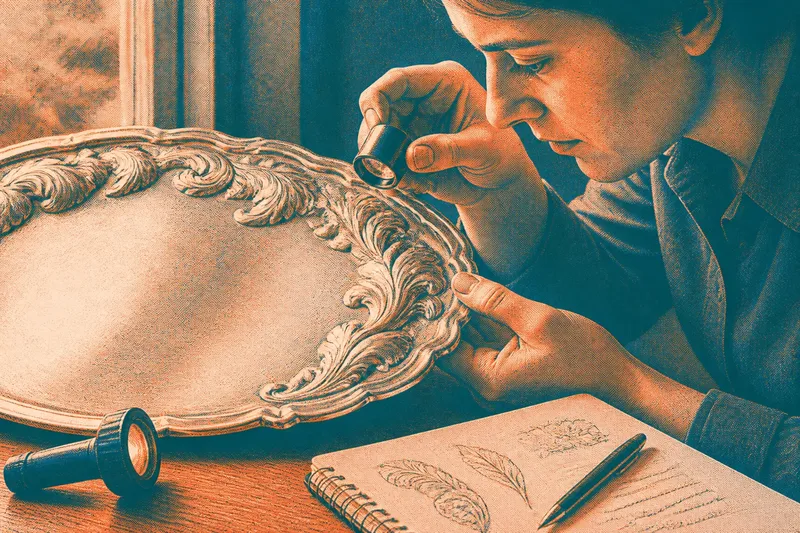
Is that pattern cut into the silver, or does it rise from the surface? To distinguish engraved or cast decoration, look closely at its edges and shadows rather than relying on a glance across the room. The goal is to describe what the surface is doing, not to force a certain identification.
Start with the shadows and the surface
Set the object on a stable table near a window, and turn it slowly rather than moving your face over it. Soft daylight from the side helps show shallow grooves and raised forms. A small flashlight can help in a dim room, but keep it away from the metal. Look without rubbing: fingerprints and old polishing marks can distract from the pattern.
Engraving removes metal to make lines, cuts, or small areas of texture. Those cuts usually sit below the surrounding surface. Cast relief begins as a raised form shaped during casting, so the decoration stands above the neighboring ground. Later finishing can soften edges, and an object may combine both methods.
Start with the pattern’s outline. An engraved leaf may be defined by incised veins and a cut boundary, while a cast leaf may have a raised central ridge and a rounded edge that catches light. Tilt the piece gently. A groove tends to hold a narrow shadow; a raised ridge shifts its highlight as the viewing angle changes.
Read the lines before judging the ornament
Look for lines that taper, cross, or stop cleanly. Engraved strokes can vary in width or depth as the tool changes direction. Under good light, a cut may have a fine edge on one side and a slight ridge of displaced metal on the other. That ridge alone does not identify a particular tool or maker.
Cast patterns often have softly modeled transitions: a petal swelling out of a stem, a shell with rounded ribs, or a border that rises as one continuous form. Some cast details are crisp, and some engraved marks are broad, so treat these as clues rather than rules. Ask whether the decoration seems cut into the surface or molded up from it.
Imagine you are examining a silver tray with a curling-leaf border. The hypothetical starting point is one leaf with narrow, recessed veins and an outer edge that rises only slightly. You tilt the tray under side light and compare that leaf with the next: if the veins remain cut into the ground, you might describe the detail as engraved; if the whole leaf stands above the ground with rounded veins, cast relief is a more plausible reading. If the evidence differs across the pattern, record “possibly combined” rather than choosing one label for the whole border.
Compare repeated motifs and the ground
Follow a repeated border around the object. Cast motifs can recur with nearly identical shapes because they come from a common mold or related process. Look for matching curls, leaf tips, or tiny ridges. Repetition supports a casting interpretation, but makers can also repeat hand engraving with a guide, a template, or practiced motions.
Then inspect the flatter ground between motifs. A cast relief may leave a subtly granular or uneven background, especially if it has not been heavily finished. Engraved decoration may sit on a comparatively smooth field, with cuts interrupting that surface. Later chasing, polishing, or other finishing can alter both appearances, so the surface may record several stages of work.
For a useful note, describe the evidence: “repeated raised leaves with rounded veins” or “fine recessed lines on a smooth field.” That language keeps observation separate from interpretation. A magnifier can help you see edges, but a phone camera’s close-up setting may distort scale or sharpen shadows in misleading ways.
Use a short routine to read the decoration
- Place the silver on a stable surface and choose soft side light. If the pattern is evenly lit and its edges are hard to see, move the light to one side; if it is already clear, keep the lighting steady for comparison.
- Choose one line or motif and tilt the object gently. If the feature sits below the surrounding ground and holds a narrow shadow, record it as a cut; if it projects above the ground and catches a shifting highlight, record it as raised.
- Compare the chosen feature with a nearby repeat. If the shapes and small details closely match, note that repetition supports a cast reading; if they vary, describe the differences and do not rule out handwork.
- Inspect the ground between motifs without touching it. If it appears relatively smooth with cuts interrupting it, record that observation alongside the lines; if it looks uneven or modeled, note the texture without treating it as decisive.
- Write a short description before assigning a technique. If the notes show both recessed cuts and raised forms, describe the decoration as possibly combined; if the evidence points mainly one way, use “engraved” or “cast relief” with the observations that support it.
- If the surface remains difficult to read, change the light angle and inspect another part of the motif. If the distinction matters for attribution or value, ask a qualified silver specialist; otherwise, keep the uncertainty in your notes.
What do people ask about engraved or cast decoration?
What does an engraved line look like?
It usually sits below the surrounding surface and may taper or change width along its path. Side lighting can make the cut’s edge and narrow shadow easier to distinguish.
What does cast relief look like?
The ornament tends to project above the ground, with rounded transitions or raised ridges that catch light. Repeated forms may share small details, though repetition alone cannot settle the question.
Can one silver object use both methods?
Yes. A raised cast flower may have engraved veins, or a cast border may be sharpened with cut lines after forming. Describe each visible feature instead of assigning one technique to the entire object.
What should I do if the surface is hard to read?
Change the light angle, inspect another part of the motif, and write down what remains visible. If the distinction matters for attribution or value, ask a qualified silver specialist rather than relying on a guess.
Keep the examination gentle and useful
Compare a few features: one line, one raised edge, and one repeated detail. Make notes or take a picture with the light direction recorded. If you return to the object later, the same angle can help you assess whether your interpretation still fits. Keep the piece supported, and do not scrape, polish, or apply chemicals to expose a detail; where handling or cleaning is uncertain, ask a qualified conservator.
Searching for one visual clue that settles every case is not worth the effort. Casting and engraving can overlap, and wear or finishing may blur the evidence. A careful description is often more useful than a confident label.
Use “engraved” when the decoration is visibly cut into the surface, “cast relief” when forms clearly rise from it, and “possibly combined” when both kinds of evidence appear. For engraved or cast decoration, a careful look at shadows, edges, and repetitions can make a modest but useful record of how the silver was made. Leave room for a specialist’s judgment when the identification matters.