A First Look Through an Inherited Silver Drawer
Sort an inherited silver drawer by broad object type, record visible inscriptions, and keep uncertain identifications open while you decide what to examine next.
What should you do when an inherited silver drawer holds a jumble of spoons, small dishes, unfamiliar tools, and pieces with names you don’t recognize? Start with a calm inventory, not a verdict. Sorting inherited silver by broad object type makes the assortment easier to see, while a separate note for inscriptions preserves clues without forcing an identification too soon.
When the assortment feels too mixed to begin
A drawer can seem impossible to organize when its contents range from teaspoons to a single long-handled implement. That does not mean the pieces belong together or that you need to know their purpose before you can sort them. Your first useful distinction is simply between objects that seem alike and objects that do not.
Lay a clean towel on a stable table and bring out a manageable group at a time. Keep small pieces together in a shallow tray or on a separate part of the towel so they are less likely to slide or disappear among larger objects. Avoid stacking pieces if they might scratch one another.
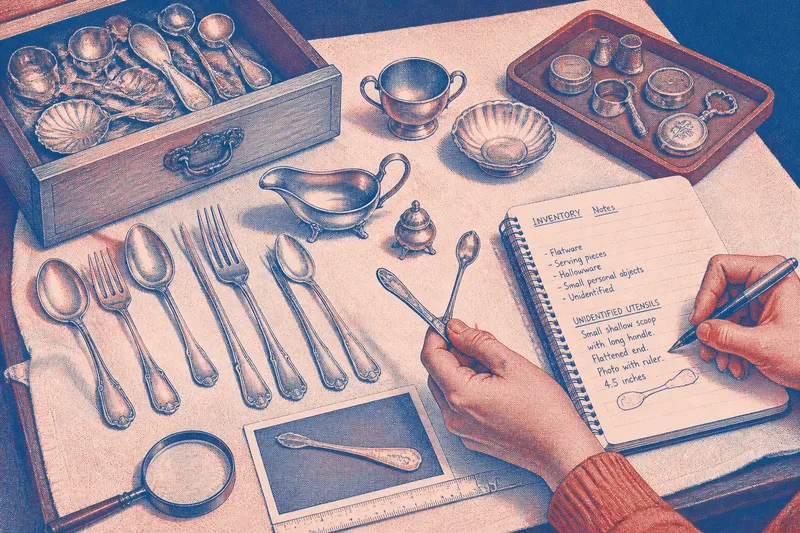
Make broad groups such as flatware, serving pieces, hollowware, small personal objects, and unidentified items. Flatware includes familiar eating utensils; hollowware covers objects with a basin or body, such as bowls and cups. Serving pieces can remain a loose group if you cannot tell whether something is a ladle, pastry server, or another specialized utensil.
These are working groups, not claims about value, date, or intended use. A piece may move later when you find a matching example or a clear inscription. For now, keep the categories broad enough that you can sort without pretending to know more than you do.
When a piece refuses to fit a category
Unfamiliar shapes often invite a quick guess. A narrow scoop may look like a serving utensil, a small vessel may seem decorative, and a hinged object may have a use that is not obvious from its outline. Guessing can make a tidy inventory feel satisfying, but a confident label can also bury uncertainty that matters later.
Give each unclear object a temporary place marked “unidentified” or “possible serving piece.” Add a neutral description: “small shallow scoop with a long handle,” for instance. Record what you can observe—the general shape, whether it has a lid or hinge, and any visible decoration—without turning those details into a story about its original use.
Imagine you find a slender implement with a flattened end among several spoons. You place it in “unidentified utensils,” describe the end and handle in your notes, and photograph it beside a ruler for scale. The result is an item that can be compared or shown to someone knowledgeable later, without a premature name steering the search.
It is not worth the effort to search every unusual silhouette online while the drawer is still unsorted. Similar-looking objects can serve different purposes, and search results may encourage a neat answer without enough evidence. A clear description and a preserved photograph are a better starting point.
When inscriptions are visible but hard to read
Names, initials, dates, monograms, and short messages can connect an object to a person or occasion, but they do not always identify the maker or explain the object’s function. Some marks may be faint, crowded, or partly hidden by wear. Treat what you see as a clue to record, not a conclusion to announce.
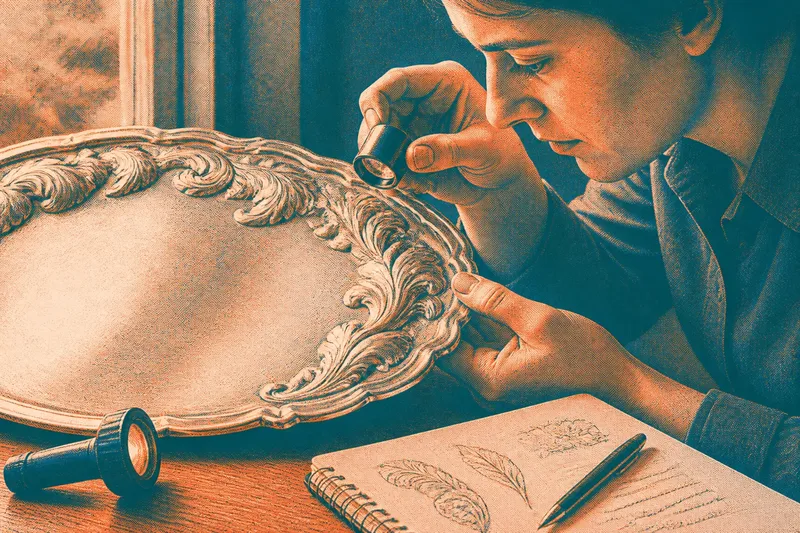
Use a soft light from the side to make shallow lettering easier to see. A phone photograph taken straight on can preserve the overall mark; another at a slight angle may show its shape more clearly. Write down the exact visible characters, including question marks where a letter is uncertain. Keep your reading separate from your interpretation: “A. R.?” is more useful than silently converting it into a full name.
Note where the inscription appears, too. A mark on the back of a spoon handle is different from lettering inside a bowl or beneath a base. Do not polish, scrape, or use an abrasive tool to make a mark clearer; that can alter the surface and remove evidence. For an object that seems significant or unusually delicate, a qualified silver specialist or conservator can advise on examination.
Maker’s marks and other stamps may be present as well, but a small symbol can be difficult to distinguish from wear or decoration. Photograph it and record its location before trying to interpret it. If a mark cannot be read confidently, label the note “unread” rather than filling the gap with a guess.
When similar pieces seem to belong together
Repeated forms are useful to notice, but resemblance alone does not prove that objects were bought as a set. A drawer may contain pieces gathered over time, inherited from different relatives, or kept together simply because they were useful. Make a group of similar-looking objects, then record the reason for the grouping.
For example, you might note “four small forks with similar handles” rather than “four-piece set.” Compare details such as handle shape, decoration, visible inscriptions, and marks, while keeping each item’s own description. If one fork has different lettering or a different pattern, record that difference instead of forcing it into the group.
Useful groupings can also be based on where objects were found. If several items were wrapped together or stored in a labeled box, preserve that information in your notes. It may be meaningful, or it may reflect a later packing choice; either way, the original arrangement is a clue worth keeping without treating it as proof of shared history.
When labels start sounding more certain than the evidence
Early labels often become durable. Once a piece is called “the sugar spoon” or “Grandmother’s wedding gift,” later readers may repeat the name without knowing it began as a guess. Use language that shows the difference between observation, family recollection, and identification.
- Observation: “Small bowl, short handle, initials near the end.”
- Family recollection: “A relative remembered it being used for preserves.”
- Uncertain identification: “Possibly a sugar spoon; purpose not confirmed.”
- Confirmed from an object or document: Record the source alongside the identification.
If you make a digital inventory, include a photograph, a plain description, the current category, visible inscriptions, and a note about what remains uncertain. A simple spreadsheet or notes app is enough; a specialized database is not necessary for a first pass. Give each item a stable label so that “small bowl with worn monogram” still points to the same object after it moves to another drawer.
For a family account, keep the speaker and wording clear. “Aunt Mara recalled that this belonged to her parents” is different from “This belonged to the grandparents.” The first preserves both the memory and its source; the second can make a recollection sound like a documented fact.
What should you do when an identification is uncertain?
Should I sort by object type or by maker’s mark?
Begin with broad object type because it lets you compare like forms without needing to read every mark. Record maker’s marks as a separate clue, then revisit any group that develops a clear pattern.
Should I clean a piece before photographing its inscription?
Usually, begin with a photograph under good light rather than cleaning for legibility. If a mark remains unclear or the object appears delicate, ask a qualified professional before attempting treatment.
What if I cannot tell what an object was used for?
Keep it in an unidentified group and write a description based on visible features. A cautious note leaves room for later comparison and is more dependable than a confident guess.
Can a family story help identify a silver object?
Yes, as context, especially when you record who shared the memory and how they described the object. Keep recollection distinct from a mark, receipt, photograph, or other evidence that can be examined directly.
When several people are sorting the same drawer
Different relatives may recognize different names, habits, or family stories. Rather than choosing one account immediately, record the versions separately. A note can say, “One relative recalls it as a dessert spoon; another remembers it beside the coffee service.” The disagreement may eventually be resolved, or it may remain part of the object’s history.
Before moving items into storage, make sure the notes and photographs are tied to the correct objects. Keep labels removable and gentle, and avoid adhesive directly on silver. If objects will be handled or stored long term, use suitable protective materials and follow care guidance appropriate to the item; unusual finishes, attachments, or delicate construction may warrant advice from a conservator.
An inherited silver drawer does not need to become a solved puzzle in one afternoon. A broad grouping, a faithful record of visible inscriptions, and a clearly marked unknown are already useful results. That first inventory gives you a steadier way to ask better questions later, while letting the objects remain more interesting than the labels you have not yet earned.
For a first look through an inherited silver drawer, the most useful habit is to keep observation and interpretation side by side, but never confused. A note such as “possible serving piece; inscription partly legible” preserves what you know and what you still need to learn. That small distinction helps the next person handle the object with curiosity rather than inherited certainty.